
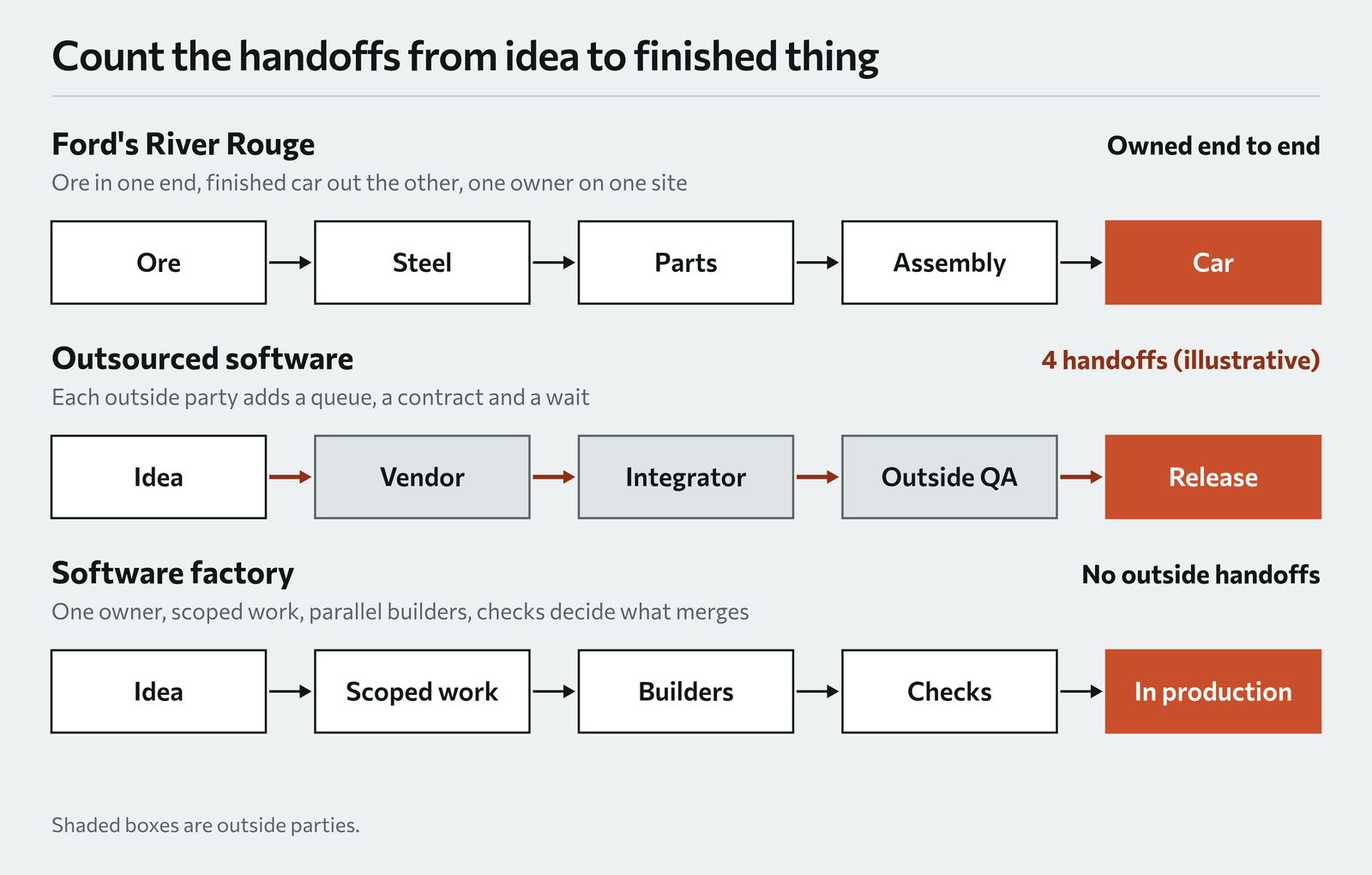
Henry Ford’s River Rouge plant took iron ore in at one end and put finished cars out the other, and it was the only place on earth where you could watch the entire automaking process in a single day. At its peak in the 1940s more than 100,000 people worked there, which is the part of the story we tend to skip. Owning every step meant employing a small city, and that cost is a large part of why the model lost. By 2001 Forbes was reporting that vertical dis-integration was the order of the day in autos, computers, printers and cameras, and a former Chrysler vice chairman was raising money for a car company with 20 employees that would own none of the factory.
I think we’re seeing history rhyming, and this is one of the verses of that rhyme. Having built and scaled multiple companies, including Leverage AI, which we sold earlier this year, I’ve seen firsthand that even with more people and more money I was often the bottleneck. What I’m building now, which I covered in The Founder Shouldn’t Be the Bottleneck, is a small software factory, where an AI technical program manager scopes the work, several AI builders run in parallel and the required checks decide what merges (the mechanics are in how we build Tapestry). Below is why I think it works and how manufacturing history can be a guidepost.
The default that is now wrong
Most companies still run on the idea that when the work grows, you must hire, and that a bigger team is a sign things are going well. That was a sensible default for as long as people were the only way to make software. I think that model is now wrong, because an AI-enabled software factory is a modern-day form of the manufacturing playbook, with one small group owning the path from intent to release at the price of compute vs payroll. Comparably, the traditional strategy of hiring more people adds inertial bloat through handoffs, queues and meetings. Agents add coordination cost too, but in my experience far less than a new hire does.
What ownership used to cost
Ronald Coase’s answer to why firms exist was simple: a company owns a workflow in-house when it is cheaper than buying, and buys it when it isn’t, so the edge of the company sits where those two intersect. For a long time, the internal cost of software was almost entirely people, because every additional person also adds communication, onboarding, review and alignment. In many workflows, renting (or outsourcing) the capability was usually cheaper than owning it, so software companies spent twenty years buying whatever was not core.
With the introduction of agents, the internal side of the equation rebalances, and capacity can be added without additional headcount that requires additional steps such as recruitment and alignment, so the price of making something yourself falls while the price of buying it, along with the contract and the wait, stays constant.
Who is already building this way
The clearest public example is StrongDM, where a small team runs what Simon Willison described in February as non-interactive development: specs and scenarios drive agents that write code and run harnesses, and by the team’s own rules humans neither write nor review the code. Dan Shapiro, who laid out five levels of AI-assisted development, puts the top level, the dark factory, with teams of fewer than five people. Those teams can work that way because they own the whole path from specification to release, so a decision made at one end reaches the other without crossing a boundary.
Hiring is moving the same direction. Tobi Lutke told Shopify staff in 2025 that teams must show why they cannot get a job done with AI before asking for more headcount. Separately, Cash Capital’s summary of Forbes reporting puts AI-native startups at $2 million to $4 million per employee against about $300,000 for the average public software company, with the caveat that inference is the new headcount and lands in cost of goods sold, so a company can look extraordinary on one measure and mediocre on gross margin.
Pattern one: the gain comes from removing handoffs
What made the Rouge work was flow, since everything from ore to assembly sat in one place and nothing waited on an outside supplier’s schedule. Software has its own version of this, which is the clarifying question sitting in someone’s backlog or inbox to review. In the example of Tapestry, a beta user flagged a bug that became a scoped assignment, a merged change and a release in about eight hours, with me at the front deciding what to build and the user at the back confirming it worked. That was among the quickest of the 28 fixes I traced, and a typical one took closer to a day, so it shows what the loop can do and not what it usually does.
Pattern two: remove one bottleneck and the next one appears
Any plant manager knows that speeding up one station just shows you the next slowest one. In my case taking myself out of the routing moved the constraint to verification and release. Merged pull requests rose from 284 in the week of October 12 to 409 in the week of November 2, but a typical change took longer from first commit to merge, about 0.8 hours with one builder and 3.2 with four, because more builders meant more review and more checks per change. That is an example of a factory’s quality system growing alongside its output, and a reminder that volume is not speed.
Pattern three: decide what stays outside the walls
Ford’s attempt to own his rubber supply in the Amazon never produced a drop of latex that went into a Ford car, because growing a crop is not something you can run like an assembly line. Integration pays where the work can be written as a specification and a check, and it fails where it can’t. This means I still buy anything that comes down to judgment or trust, and I keep product judgment for myself, since what to build comes from conversations with users.
Where I could be wrong
The economics could point the other way. One recent paper on the headless firm argues that cheaper coordination breaks companies into protocol-connected specialists, which is the opposite of integration and may end up being right in fast-moving domains. A factory nobody reviews is only as good as the tests that judge its work, and a team that ships faster can also build the wrong thing faster. That is the real risk, and it is why a person still has to decide what is worth building. As one essay on software factories puts it, whatever a factory delivers needs an owner and a path to retirement.
A way to use this
For any function you are about to hire for, I’d ask what it would cost to own end to end if the labor were agents, and then count the handoffs between the idea and what’s running in production. Ford paid 100,000 people to remove those handoffs, and a small team can now remove many of them for the price of compute. The part that does not transfer is Ford’s rubber, so before integrating anything I would ask whether its quality can be written down as a specification and a check, because if it can, you should own it.